

Apple files lawsuit against OpenAI, accusing it of stealing trade secrets
In 2024, Apple and OpenAI partnered to bring ChatGPT to the iPhone. Now, Apple has filed a lawsuit against OpenAI In the US District Court for Northern California. This isn’t the first time OpenAI has been sued, but it could be the biggest yet. OpenAI has drawn the ire of many, including allegations that it trained its AI models on data obtained illegally from third parties, thus infringing copyright. But, Apple’s lawsuit is very heavy. It alleges that OpenAI stole trade secrets that were vital to Apple’s technology research, product development, manufacturing and more. Apple says OpenAI has failed to respond to its letters addressing concerns about confidential information.

The Cupertino company has claimed that OpenAI asked job candidates to share secret details about Apple’s projects, and even gained access to prototype hardware and device components. It alleges that Tang Tan, a former VP of Apple Watch, coached job candidates on how to circumvent Apple’s security procedures in order to leave the company. Apple claims Tan also asked potential candidates to bring Apple hardware and talk about them during their interviews.
Former iPhone system electrical engineer Chang Liu reportedly gained access to the laptop of his former colleague, Yu-Ting Elisa Peng. This was an Apple-owned device that was used to gain access to Apple’s network after Liu joined OpenAI. He managed to download technical documents from Apple’s servers. Liu also obtained details about unannounced products from an Apple employee to help Peng prepare for a job interview.
It is said that Apple believes that OpenAI’s hardware ventures can be based on its technology. “OpenAI’s nascent hardware business now rests on the weakest foundation, completely rotten due to its illegal reliance on misappropriated trade secrets,” Apple writes in its lawsuit. OpenAI, on the other hand, seemed nonchalant and said “We’re not interested in other companies’ trade secrets. We’re focused on building innovative technology that empowers people everywhere.”
OpenAI has announced a macro pad, and may launch a smart speaker soon
OpenAI has launched a device called Codex Micro. It is a compact keyboard product, which was developed as a collaboration between OpenAI and Work Louder. The Codex Micro is designed for productivity and has 13 mechanical keys, and its design is similar to another macro pad from Louder, the Creator Micro 2. The device also has a joystick, a dial, and a touch sensor.

The Codex Micro has 6 keys that are frosted, and these change color to indicate the live status of a function. It will change color to indicate that a task has been completed, needs feedback, is in progress, or an error has occurred. Other keys include common actions like accepting changes, rejecting output, push-to-talk, starting a new chat, triggering custom actions. Work Louder says the keys can be re-mapped, and users can customize the device with 32-included icon keycaps. Controls can be re-mapped using the ChatGPT desktop app.
OpenAI says the Codex Micro is a limited edition product and will cost $230. Rumors suggest that OpenAI may soon launch its first AI-powered product, it is said smart speakerWhich serves as a screen-less companion to ChatGPT. It’s unclear how this could happen, given that OpenAI is being sued by Apple regarding theft of hardware technology.
EU orders Google to give rivals more access to Android and search options
EU has ordered Google To allow competitors to have greater access to Android and Search. These rules are part of 2 sets of measures to ensure Google’s compliance under the Digital Markets Act.
According to the report, AI assistants created by third parties have limited access to key functionalities on Android. It says that since alternative AI apps are restricted, they cannot compete with Google’s Gemini AI, which has full access to the OS. This appears to make third-party AI assistants less attractive. The European Commission says it wants users to have more options to set up their preferred AI assistant, and also improve users’ privacy.

Currently, users cannot select a specific AI assistant as the default app on their Android devices, which works in Gemini’s favor. This is something the EU wants to change. It wants to allow users to choose which AI assistant app should be activated with a voice command like “Hey Google.” It can also help the user delegate tasks to the AI, or ask him to interact with the AI about a recently visited place, recommending suggestions for relevant answers in chat and other apps.
Google’s offer to share its searches has been ineffective. The Mountain View company had specified that AI chatbots that provide search functionality are eligible to receive shared data, subject to anonymization. But the EU wants to give third-party search engines access to the data Google Search may collect, to ensure better competition between search services.
Mozilla will release Firefox updates once every 2 weeks
Mozilla has announced that it will release an update for Firefox once every 2 weeks. The previous release cadence followed a 4-week pattern, which meant that a new version was released once every month. This is similar to what Google announced for its recent Chromium release. Mozilla is already releasing point-updates several times a month to fix bugs.
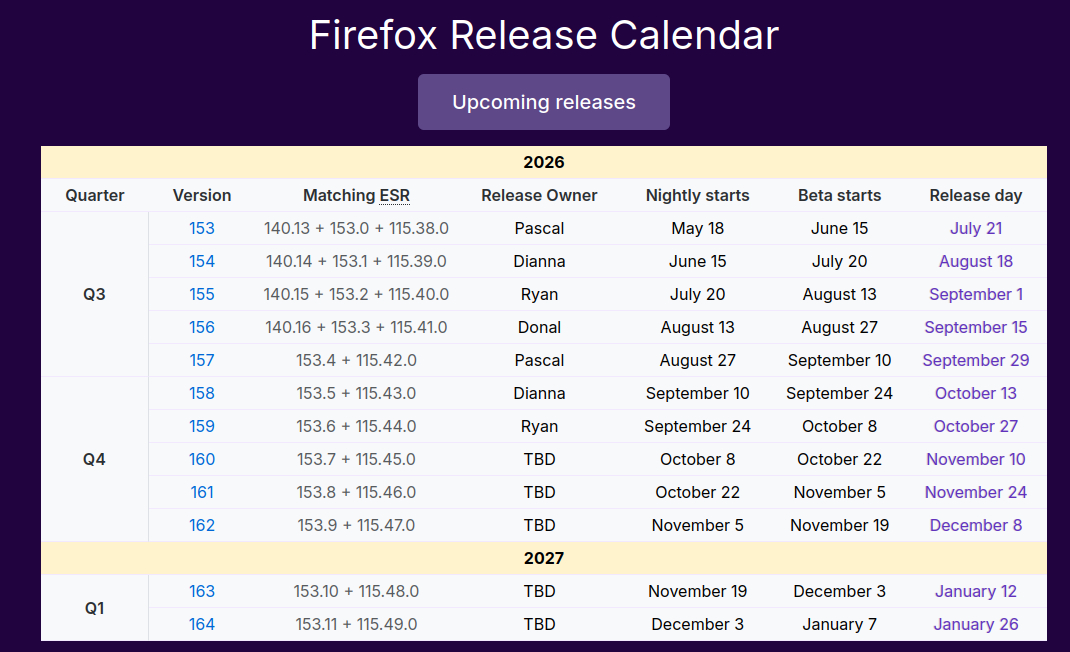
But it’s stuck on a monthly-release pattern for version updates, for example 151 to 152, 152 to 153, etc. According to Mozilla, the move towards a faster release cycle is experimental, and will be used to analyze whether it is beneficial. The nonprofit organization says the development of features will not be rushed due to the change, and Firefox developers will add new features to the browser only when they are ready.
chip.in report Mozilla will move to a 2-week release cycle starting September 1, 2026, when Firefox 155 will be released. Users can expect new features to be available earlier than before.
Google’s NotebookLM has been renamed Gemini Notebook
Google is again in the same situation, it is changing the name of its other services, without any reason. This time, it’s NotebookLM, which has been renamed gemini notebook. NotebookLM debuted at Google I/O 2023. It allows users to turn their notes into an AI podcast, which can become a personal research tool. Google has updated it with new features like narrated slide shows, creating short video clips.

Now, it can do even more. Gemini Notebook Connects Gemini Notebooks can connect to Google’s ecosystem, including Search and Gemini apps. Google says the Gemini notebook will remain a standalone product.
Additionally, Google is adding the ability to write and execute code natively in Gemini notebooks, but this feature is only available to Google AI Ultra users and Workspace business customers with AI Ultra Access and AI Extended Access. The feature will roll out to Pro users on the web in the coming weeks.


